Account Engagement (Pardot) vs Marketing Cloud: which fits?
What Salesforce Account Engagement (Pardot) and Marketing Cloud Engagement each do, who each one suits, and when it makes sense to run both.

Salesforce has two marketing automation products that people mix up all the time, partly because the names keep changing. Account Engagement is the tool most people still call Pardot. Marketing Cloud Engagement is the one most people still call Marketing Cloud, and longer-serving teams sometimes call ExactTarget, the company Salesforce bought to build it.
They share a brand and both send email, but they’re built for different jobs. Here’s how they differ, which one fits which kind of business, and what it takes to keep either one producing work every week.
Quick answer
- Account Engagement (Pardot) is built for B2B: capturing leads, nurturing them over long sales cycles, scoring and grading them, and handing the best ones to sales inside Salesforce.
- Marketing Cloud Engagement is built for high-volume, mostly B2C marketing: large audiences, many channels, and personalized journeys driven by customer data.
If your revenue depends on a sales team closing deals, start by looking at Account Engagement. If it depends on reaching large numbers of consumers across email, SMS, and app messaging, look at Marketing Cloud Engagement.
A note on names
Salesforce renamed Pardot to Account Engagement in 2022, and you’ll also see “Marketing Cloud Account Engagement.” Around the same time, the product long known simply as Marketing Cloud became Marketing Cloud Engagement. Salesforce is also building newer marketing products on its Data Cloud platform, so the line-up and names may well shift again. The capabilities in this article are the long-standing core of each product; check with Salesforce for current editions and pricing.
What Account Engagement does
Account Engagement is a B2B marketing automation platform that sits close to Sales Cloud. Its core jobs:
- Lead capture. Forms, landing pages, and form handlers turn website visitors into prospects, and tracking connects their later visits and email clicks to their record.
- Nurture. Engagement Studio lets you build programs that send emails, wait, check what a prospect did, and branch based on their behavior and data. It’s designed for the long, multi-touch sales cycles of B2B.
- Scoring and grading. Scoring adds points for activity, such as page views, form fills, and email clicks, to show how interested a prospect is. Grading rates how well they match your ideal customer profile, from A to F. Together they help decide who is ready for sales.
- Sales alignment. Prospects sync with leads and contacts in Salesforce, so sales reps see marketing activity on the record, and marketing can see what happened to the leads it passed on. Automation rules and completion actions can assign leads, notify reps, or add people to Salesforce campaigns.
- Reporting. Because it shares Salesforce campaigns, you can connect marketing activity to opportunities and pipeline.
The trade-off: Account Engagement is not built for very large consumer audiences, complex multi-channel journeys, or the heavy data work B2C brands often need.
What Marketing Cloud Engagement does
Marketing Cloud Engagement is a separate platform, with its own interface and data, designed for large-scale, cross-channel marketing. Its core parts:
- Email Studio and Content Builder for building and sending email at volume, with templates, reusable content blocks, and personalization.
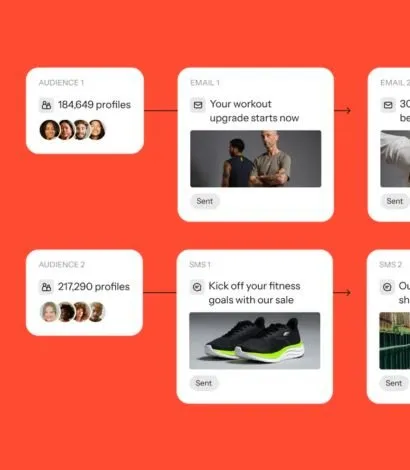
- Journey Builder for automated, multi-step customer journeys triggered by events, data, or audience entry, across email, SMS, and push.
- Contact Builder and data extensions. Data lives in data extensions, which work like database tables, and you define how they relate to each other. This gives you a lot of flexibility to model customers, orders, and products, but it needs someone who understands data to set up and maintain.
- Mobile messaging through MobileConnect (SMS) and MobilePush (app notifications).
- Automation Studio for scheduled data jobs, such as imports, SQL queries, and segment refreshes.
It can connect to Sales Cloud and Service Cloud through Marketing Cloud Connect, but that alignment is something you set up, not the starting point it is for Account Engagement.
The trade-off: Marketing Cloud Engagement is powerful and flexible, and that flexibility comes with complexity. Teams often need technical skills, such as SQL or Salesforce’s AMPscript scripting language, to get the most out of it.
Side by side
| Account Engagement (Pardot) | Marketing Cloud Engagement | |
|---|---|---|
| Audience | B2B: businesses selling to businesses | Mostly B2C: brands selling to consumers |
| Typical use | Lead capture, nurture, and handing qualified leads to sales | High-volume email, SMS, and push, plus personalized customer journeys |
| Automation tool | Engagement Studio, automation rules, and completion actions | Journey Builder and Automation Studio |
| Data model | Prospect records synced with Salesforce leads and contacts | Flexible data extensions, related in Contact Builder |
| Sales alignment | Built in: shared records, campaigns, and lead assignment in Salesforce | Optional, through Marketing Cloud Connect |
| Who usually runs it | Marketing ops or demand gen teams, working with sales | CRM or lifecycle teams, often with technical or data specialists |
When to choose Account Engagement
Account Engagement usually fits when:
- You sell to businesses, and a sales team closes the deals.
- Your sales cycle is weeks or months long, with several people involved in each decision.
- You already run Sales Cloud and want marketing and sales working from the same records.
- Your biggest questions are “which leads are ready?” and “what did marketing contribute to pipeline?”
- Your marketers want to build and change nurture programs themselves, without writing code or SQL.
When to choose Marketing Cloud Engagement
Marketing Cloud Engagement usually fits when:
- You sell to consumers, or to very large audiences of any kind.
- You need several channels, such as email, SMS, and app push, coordinated in one journey.
- You have rich customer data, such as orders, products, loyalty, and app activity, and want to use it to personalize messages.
- You send large, time-sensitive campaigns, such as a sale launch or a service update, to big audiences at once.
- You have, or can access, the technical skills to manage data and build at scale.
When companies run both
Some organizations run both, usually for one of these reasons:
- Separate B2B and B2C businesses. A company sells to trade customers through a sales team and to consumers online, and each side uses the tool built for it.
- Different jobs for different audiences. A large B2B company uses Account Engagement for sales-aligned nurture, and Marketing Cloud Engagement for high-volume communications to its customer base, such as newsletters, onboarding, or service messages.
Running both works, but it needs rules. Decide which platform owns which audience and which messages, keep unsubscribes and consent in step between them so nobody keeps getting emails they opted out of, and agree on how reporting comes together. Without that, the same person can receive overlapping emails from two systems, and nobody can see the whole picture.
Keeping either one shipping week to week
Choosing and implementing the platform is the start. The harder part is keeping it busy with good work. Whichever one you run, a healthy week usually includes:
- New content. Emails, landing pages, and nurture or journey steps need fresh copy and design. A nurture program written two years ago still runs, but it rarely still matches what you sell.
- Quality checks. Testing links, personalization, and rendering, and checking who enters each program or journey before it goes live.
- Data upkeep. Clean lists, correct fields, and segments that still mean what their names say.
- Tuning. In Account Engagement, reviewing scoring and grading with sales, so the threshold for a sales-ready lead reflects reality. In Marketing Cloud Engagement, reviewing journey performance and the data behind the personalization.
- Reporting. A regular read on what’s working, shared with the people who decide what happens next.
This is where many teams get stuck: they have a capable platform and too few hands to run it at the pace it allows.
How the studio helps
We run marketing inside both platforms. In Account Engagement, we build B2B nurture programs in Engagement Studio, forms and landing pages, scoring and grading tuning, and campaign reporting. In Marketing Cloud Engagement, we ship email and messaging campaigns, Journey Builder journeys, content and templates, and campaign reporting. Senior marketers set the direction and review the work, and our AI platform, Growth Minds Studio, helps us produce copy and design in your brand voice, so the work keeps moving every week.
Platform selection, implementation, data models, and Sales Cloud integration are handled by Great Minds, the consultancy behind the studio. Growth Minds is backed by Great Minds, an official Salesforce partner.
See what we do in Salesforce Account Engagement and Salesforce Marketing Cloud Engagement, how we approach marketing automation, or book a studio walkthrough.
Frequently asked questions
Account Engagement, still widely called Pardot, is Salesforce's B2B marketing automation tool: it captures leads, nurtures them over long sales cycles, scores and grades them, and hands the best ones to sales inside Salesforce. Marketing Cloud Engagement is a separate platform for high-volume, mostly B2C marketing, with large audiences, email, SMS, and push, and personalized journeys driven by customer data. Both send email, but they're built for different jobs.
Yes. Salesforce renamed Pardot to Account Engagement in 2022, and you'll also see it called Marketing Cloud Account Engagement. Around the same time, the product long known as Marketing Cloud became Marketing Cloud Engagement, which some longer-serving teams still call ExactTarget, after the company Salesforce bought to build it. Salesforce is also building newer marketing products on its Data Cloud platform, so the names may shift again.
For most B2B businesses, Account Engagement is the place to start. It fits when a sales team closes the deals, sales cycles run weeks or months with several people involved in each decision, and you already run Sales Cloud. Prospects sync with Salesforce leads and contacts, scoring and grading show who is ready for sales, and marketers can build nurture programs in Engagement Studio without writing code or SQL.
Yes, and some organizations do, usually because they run separate B2B and B2C businesses, or because a large B2B company uses Account Engagement for sales-aligned nurture and Marketing Cloud Engagement for high-volume communications such as newsletters, onboarding, or service messages. Running both needs rules: decide which platform owns which audience and messages, keep unsubscribes and consent in step between them, and agree on how reporting comes together.
Often, yes. Marketing Cloud Engagement stores data in data extensions, which work like database tables related in Contact Builder, and Automation Studio runs scheduled jobs such as imports, SQL queries, and segment refreshes. That flexibility is powerful but brings complexity, so teams often need SQL or Salesforce's AMPscript scripting language to get the most out of it. It's usually run by CRM or lifecycle teams with technical or data specialists.